
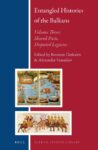
The studies in this volume present some of the major “historiographical wars” over the medieval Balkan past fought by the historians of competing nation states in the region. Еthnic origins and “national” makeup of medieval states and disputed regions; ownership of the historical heritage located in or associated with that territory; provenance or “national” consciousness of important historical personalities; the boundaries of a certain medieval state and its political, religious, and cultural influence on others – these are some of the issues around which major clashes between the modern Balkan historiographies recurred. The book is valuable to all those interested in how the medieval past becomes instrumentalized by the “national historians” in the service of constructing the national canons of history. Table of contents: Legacy, Tradition, Heritage and the History Writing in the Balkans Diana Mishkova Pages 1-50 Controversies Over Samuеl’s State Roumen Daskalov Pages 51-103 Skanderbeg: Figures of Paper, Figures of Stone Nathalie Clayer Pages 105-159 Art Wars: The Creation of Bulgarian Art History and the Balkan Controversies Over the Medieval Heritage of Macedonia Tchavdar Marinov Pages 161-218 Defending Our Lands in Ancient and Medieval Studies: The Albanian Case Alexander Vezenkov Pages 219-273 In Search of an Acceptable Past: The Bosnian Middle Ages and National Ideologies Nedim Rabić Pages 275-317
It is a well-known fact that the medieval history of the Balkan societies and states was largely shaped in and by their relations with Byzantium, the Eastern Roman Empire. As political entities they were formed on a territory that had for centuries been Byzantine provinces, and in time began to challenge the Empire’s political supremacy there, while the Byzantine cultural, political and institutional influence was extremely strong. Thus many aspects of the medi- eval past of the Greeks, the Bulgarians, the Serbs and the Romanians are the direct outcome of interactions between these peoples and Byzantium. In fact, most historians of the Balkans would maintain that their nations’ modern his- tory also bears, to a greater or lesser extent, the hallmark of these political and cultural entanglements.

The article sets off from a discussion of some methodological and theoretical issues pertinent to the study of ideological and institutional transfer between “centre” and “periphery” in nineteenth-century Europe. While taking into account the asymmetry in radiation and reception, it probes into the (Balkan) periphery’s political and cultural agency in reformulating and re-institutionalizing the “western model.” Rather than simply tracing movements, flows and circulation – the conventional concern of the transnational approach – the focus is on studying the transformations which occur in the process. This makes it possible to highlight the dynamics and versatility of idea- tional and institutional selection, interpretation, adaptation and transformation (or subversion) – in brief, the process of re-signification of ideas and institutions. The article then proceeds by exemplifying this approach in two directions. First, it examines several main channels and agents of transfer to and within the Balkan periphery illumi- native of the ways ideas, practices and institutions traveled and mutated in the course of their journey; second, it surveys several characteristic instances of transfer of liberal ideas and institutions in the Balkans focusing on their legitimization and “domestica- tion” which underscore the semantic and functional reinterpretations of modernity and tradition in the process.
This article takes a distance from the debate about ‘symbolic geographies’ and struc- tural definitions of historical spaces as well as from surveying discrete disciplinary traditions or political agendas of regionalist scholarship in and on Southeastern Europe. Its purpose instead has been two-fold. On the one hand, to bring to light a preexistent but largely suppressed and un-reflected tradition of regionalist scholarship with the hope that this could help us fine tune the way we conceptualize, contemplate and evaluate regionalism as politics and transnationalism as a scholarly project. In epistemological terms, on the other hand, it proposes a theoretical perspective to regionalist scholarship involving rigorous engagement with the scales of observation, and scale shifts, in the interpretation of history. The hypothesis the article seeks to test maintains that the national and the (meso)regional perspectives to history chart differentiated ‘spaces of experience’ — i.e. the same occurrences are reported and judged in a different manner on the different scales — by way of displacing the valency of past processes, events, actors, and institutions and creating divergent tem- poralities — different national and regional historical times. Different objects (i.e. spaces) of enquiry are therefore coextensive with different temporal layers, each of which demands a different methodological approach. Drawing on texts of regional scholars, in which the historical reality of the Balkans/Southeastern Europe is articu- lated explicitly or implicitly, the article discusses also the relationship between different spaces and scales at the backdrop of the Braudelian and the microhistorical perspectives.
This volume is the result of a 15-month research work which brought together young scholars from different Southeast-European academic cultures on a project initiated and hosted by the Centre for Advanced Study in Sofia in partnership with Collegium Budapest.1 The project entitled We, the People. Visions of National Peculiarity and Political Modernities in Southeastern Europe, is inscribed into a broad and daunting design: to help craft a more coherent methodological and structural framework for dealing with questions of collec- tive identity and the institutionalization of national discourse in the context of “late-coming” nation-state projects. In undertaking this task, we focused on a particular, yet critical area: exploring the political instrumentalization of key concepts describing collective identity, such as nation, folk, people, ethnos, national tradition, race, etc., with the purpose of “mapping” the discursive and institutional itineraries through which this set of notions became a focal point of cultural and political thought in various Southeast-European contexts, co- incidental with the emergence of political modernity. Our intention was thus to grasp the processes of actual emergence of the terminology of collective identity in these cultures during the long 19th century.
The aim of this article is to interrogate the current mainstream interpretation of the relations between the Balkans and the West by exploring the agencies of the transmission of knowledge through which the Balkans became familiar with the West. Interest is focused on how concepts about ‘us’ and the ‘other’, cultural and social self-definitions were historically mediated by concepts of Europe. Issues of cultural transfer form a point of departure, in this sense suggesting that Balkan visions of Europe cannot be understood as simply mirroring the representations of the Western hegemonic discourse about the Balkans. In order to understand these visions, more attention needs to be paid to local and regional dynamics in the production of ideologies and self-narrations.