
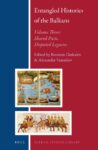
The studies in this volume present some of the major “historiographical wars” over the medieval Balkan past fought by the historians of competing nation states in the region. Еthnic origins and “national” makeup of medieval states and disputed regions; ownership of the historical heritage located in or associated with that territory; provenance or “national” consciousness of important historical personalities; the boundaries of a certain medieval state and its political, religious, and cultural influence on others – these are some of the issues around which major clashes between the modern Balkan historiographies recurred. The book is valuable to all those interested in how the medieval past becomes instrumentalized by the “national historians” in the service of constructing the national canons of history. Table of contents: Legacy, Tradition, Heritage and the History Writing in the Balkans Diana Mishkova Pages 1-50 Controversies Over Samuеl’s State Roumen Daskalov Pages 51-103 Skanderbeg: Figures of Paper, Figures of Stone Nathalie Clayer Pages 105-159 Art Wars: The Creation of Bulgarian Art History and the Balkan Controversies Over the Medieval Heritage of Macedonia Tchavdar Marinov Pages 161-218 Defending Our Lands in Ancient and Medieval Studies: The Albanian Case Alexander Vezenkov Pages 219-273 In Search of an Acceptable Past: The Bosnian Middle Ages and National Ideologies Nedim Rabić Pages 275-317

The subject of the present book is the historiography of the Middle Ages in Bulgaria. The book is historiographical in the old-fashioned sense—of writing on the writing of history, where “history” has a double meaning of “what hap- pened in the past” and of “writing about (what happened in) the past.” This ambiguity is now avoided by taking “historiography” to mean (literally) “the writing of history,” while writing on the writing of history is called “the history of historiography.”
The emergence and rise of the Bulgarian nation during the Revival era in the last decades of Ottoman rule is inextricably connected with the Greeks. It started as a reaction to the danger of Graecization (Helleniza- tion), the alarm over which was sounded as early as 1762 by the monk Paisiy of Hilendar Monastery. The Bulgarians first learned from the more advanced Greeks, who acted as mediators of modernity in the empire, and then turned against them and developed their own national ideology in a bitter struggle with Greek nationalism (which started earlier). But the latter also evolved under the impact of this rivalry and strife. The resulting dynamics entangled both nations with far-reaching consequences.
Balkan history has followed various courses and taken various shapes at different eras, and the studies that deal with it have attempted to make sense of it in different ways. There are the ubiquitous metaphors of a "crossroads" or "powderkeg" or a "battlefield" of civilizations. Some authors have seen ghosts of ancient hatreds haunting the region; others sought to show that such apparitions were largely imaginary. Some were concerned with drawing the borders of the region and defining its unity and distinctiveness, while others went in pursuit of an evasive human species-Homo balcanicus.
At first, the Vlachs were reluctant and turned away from the revolt urged upon them by Peter and Asan, looking askance at the magnitude of the undertaking. To overcome the timidity of their compatriots, the brothers built a house of prayer in the name of the Good Martyr Demetrios. In it they gathered many demoniacs of both races; with crossed and bloodshot eyes, hair disheveled, and with precisely all the other symptoms demon- strated by those possessed by demons, they were instructed to say in their ravings that the God of the race of the Bulgars and Vlachs had consented to their freedom and assented that they should shake off after so long a time the yoke from their neck; and in support of this cause, Demetrios, the Martyr for Christ, would abandon the metropolis of Thessaloniki and his church there and the customary haunts of the Romans and come over to them to be their helper and assistant in their forthcoming task.